Education / NEoWave Explained / What is Elliott Wave?
What is Elliott Wave theory?
Even if you only have a basic understanding of Elliott Wave Theory, you may know that it is named after Ralph Nelson Elliott,
who is credited with discovering what today is known as the Elliott Wave Principle. As it turns out, R.N. Elliott's story is just as
fascinating as Wave Theory itself!
Let's Start at the Beginning: Who is R.N. Elliott?
Born in 1871, Ralph Nelson Elliott was an accountant who worked primarily as an executive with railroad companies in Central America and Mexico.
According to a Wikipedia page about R.N. Elliott, in 1924, the US Department of State appointed him to the post of chief accountant for Nicaragua,
which was under American control at the time. During this time, Elliott wrote two books based on his professional experiences. One that might offer
a fascinating read but was never published is titled The Future of Latin America.
Upon returning to the United States, he conducted a systematic study of decades of stock market data and became fascinated with the cyclical
nature of trader psychology. The cyclical patterns of price movements became known among his followers as Elliott Waves, and this form of
technical market analysis is referred to as Wave Principal, Elliott Wave Theory, or NEoWave.
Elliott's two most well-known books (which are still popular) are:
- The Wave Principal
-
Published in 1938.
-
The description on this book's Amazon page reads: "The Elliott Wave Principle [enables you]
to analyze financial market cycles and forecast market trends by identifying extremes in investor psychology,
highs and lows in prices, and other collective factors. Ralph Nelson Elliott, a professional accountant ...
proposed that market prices unfold in specific patterns, which practitioners today call Elliott waves, or simply waves.
Elliott published his theory of market behavior in this book, The Wave Principle."
- Nature's Law: The Secret of the Universe
-
Published in 1946.
-
The description on this book's Amazon page reads: "If you are interested in technical or wave analysis, it should be required reading.
It is the definitive work on a scientific wave theory of human experience. ... such an important, fascinating work that it should be read
by every serious student of the market."
Answering a Key Question: What Is Wave Theory?
Ralph Nelson Elliott's Wave Principle measures how groups of people behave. One of the easiest places to see this phenomenon at work is in the
financial markets, where changing investor psychology is reflected in the form of price movements. While it had been thought that traders behaved
in a random and unpredictable manner, Elliott discovered they actually traded in repetitive cycles, which, it turned out, were the emotions of
investors as a result of outside influences.
The up-and-down swings of the mass psychology always showed up in repetitive patterns, which were then divided into patterns that Elliott called waves.
His Wave Theory went on to reveal that if you can identify repeating patterns in prices – and determine where those repeating patterns occur –
then you can forecast market trends.
What Do Present-Day Stock Market Analysts Think About Wave Theory?
For nearly a century, stock market forecasters and traders around the world have followed R.N. Elliott's Wave Principle – and many have invested
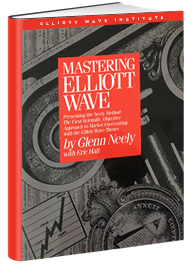
countless hours in enhancing and refining it. For example, Glenn Neely, author
of Mastering Elliott Wave, expanded on the foundational elements of
Elliott Wave Theory with his discoveries of new concepts, rules, and patterns. Neely calls his expanded approach to wave analysis and forecasting NEoWave.
He emphasized the usefulness of Wave Theory as "a unique analytical tool" in Chapter 1 of his book:
"Some of the remarkable aspects of the Elliott Wave Theory are (1) its adaptability to new technological developments and unexpected fundamental news;
(2) its thoroughness in describing ALL possible market behavior; and (3) its progress and dynamic characteristics."
A Sampling of Elliott Wave Books Published Through the Decades
Over the decades, scores of Elliott Wave experts have written books to explain wave forecasting and analysis. Their universal goal is to make Wave
analysis and forecasting more accessible – and profitable – for traders. A partial list of these books is below.
- Mastering Elliott Wave (1990) by Glenn Neely
- Elliott Wave In Motion (1988) by Glenn Neely
- Elliott Wave Perspective - Think, Reason and Trade like an Elliott Wave Analyst (2018) by Aleksander Vichev
- Practical Application of Elliott Wave Principle: The Secret to Identify Stock Market Moves (2021) by Deepak Kumar
- Elliott Waves Made Simple: Master Elliott Wave Techniques in Less Than 48 Hours (2018) by Steve Sinclair
- Visual Guide to Elliott Wave Trading (2013) by Wayne Gorman and Jeffrey Kennedy
- Elliott Wave Trading: Principles and Trading Strategies (2013) by Jeffrey Kennedy
- Elliott Wave - Fibonacci High Probability Trading: Master The Wave Principle and Market Timing With Proven Strategies (2022) by Jarrod Sanders
- Applying Elliott Wave Theory Profitably (2003) by Steven W. Poser
- Mastering Elliott Wave Principle: Elementary Concepts, Wave Patterns, and Practice Exercises (2012) by Constance Brown
- Elliott Wave For Beginners: A Quick And Easy To Understand Guide To Trading The Elliott Wave Theory (2017) by Luciano Kelly
- Market Patterns with Elliot Wave: Decoding Market Trends and building a trading edge with Elliott Wave Strategies () by Kofi Brown
- Mastering Elliott Wave Theory: A Comprehensive Guide (2023) by Ozkan Salih Ozisler
Important note: The above list is provided simply as a resource. Other than Glenn Neely's classic,
Mastering Elliott Wave, NEoWave do not endorse any of
the following books or the specific Elliott Wave analysis or Wave charting methods they may put forth. Also, be aware that some of these Elliott Wave books
were published many years ago and do not present the latest thinking about Wave theory, such as new rules, concepts, and newly discovered patterns.